
Alternative educational methods and schools are growing in popularity. Philosophies like Reggio Emilia, Montessori, and Waldorf are becoming well known.
But what is Reggio Emilia, and how does it differ from other educational practices? And–if you’re interested in the philosophy—how can you incorporate some of its practices at home?
We spoke with Stephanie Hess, Director of Curriculum at Ivybrook Academy, about her experience falling in love with Reggio Emilia and how parents who are inspired by the philosophy can use its methods at home.
Hess earned her education training from U of M in Dearborn, where they train their teachers in the Reggio Emilia approach to education. She began her career in the UM’s child development center and fell in love with how child-led the Reggio Emilia approach is.
“It’s teacher guided, not teacher directed,” said Hess. “We act as facilitators, not as directors.”
Hess appreciated that approach because it pairs teachers with children as collaborators.
“Children’s minds are not empty,” Hess said. “They have so much prior knowledge and experience. Even as infants and toddlers, they bring a lot to the classroom. They enjoy the world around them and have so much to express. It’s wonderful to see them interact with their environment.”
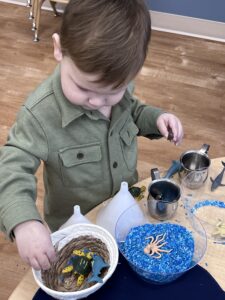
The Reggio Emilia approach views the environment as the third teacher in the classroom. Teachers set up the environment to encourage children to use the environment itself to learn. Children have access to the materials, and organically engage with the provocations (a term for intentionally chosen materials that can be played with in an open-ended way).
Teachers are in the classroom to facilitate, ask questions and encourage a child’s mind to problem solve independently.
Children are allowed to create and play at their own ability and are empowered to take ownership in their learning.
RELATED: Harvesting Independence: Montessori Fall Activities for Kids
“When a child goes into a classroom where it’s just curriculum that the teachers are directing at them, the child has no choice behind what or how they learn,” Hess said. “One of the things about Reggio is that children have hundreds of ways that they can learn. Children learn best by doing and being engaged in their learning, using their hands and their whole body–the whole child–to engage in their learning. So sitting in a chair is not going to be great for all students. Some can handle it, but many can’t.”
Rather than focusing on pen and paper worksheets, children interact with their materials and use manipulatives to guide their learning.
For parents interested in incorporating Reggio Emilia principles into their everyday routines, Hess starts with nature.
Nature is key
“Nature is key to Reggio Emilia,” she said. “Go for nature walks and gather natural materials to create.” In her classroom, they plant seeds in the spring and harvest their tomatoes and green beans several months later.
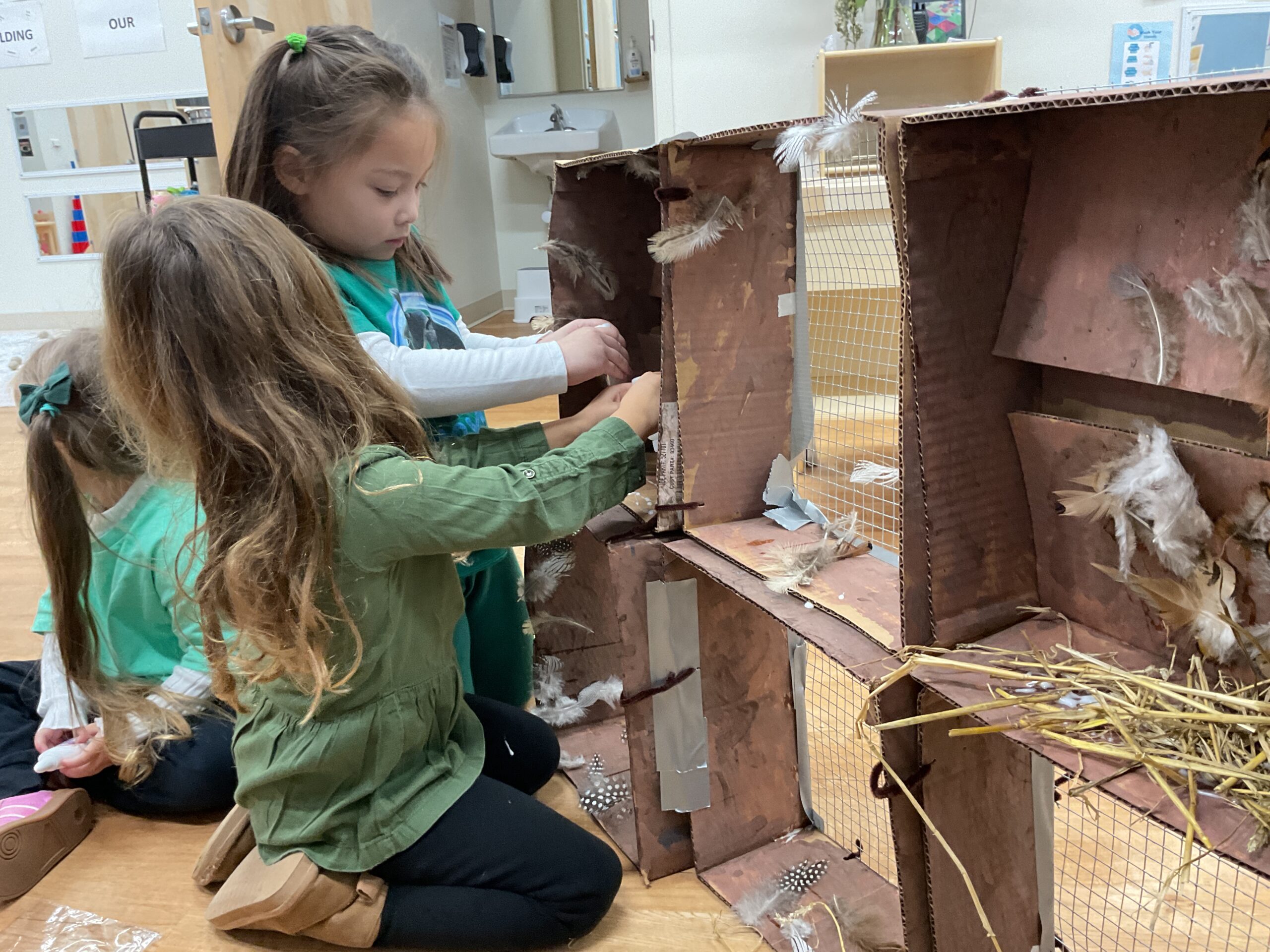
Reggio also uses recycled materials to create, and parents can easily repurpose everyday household supplies into art projects. Hess describes an experience her class had over the year, where her classroom showed a deep interest in farm animals–inspired by a student whose family had chickens that he was very excited about. The children wanted to make chickens, so they made paper plate chickens with feathers and beaks and little feet. Hess talked about where chickens live and what they eat, and the students decided they needed a house for their chickens, so they made a chicken coop.
Then the children wanted to make pigs, so they researched if they wanted to make flat or 3D pigs, and how to do it, and they settled on using recycled milk jugs, paper mache, googly eyes, and pipe cleaners for tails, with small water bottles to create piglets.
By the end of the year the classroom had created cows, with a baby cow and a mama with working udders; a duck pond, bunnies, and a barn with a door where the horses could come out of the barn.
Follow their child’s interest
Hess encouraged parents to follow their child’s interest. If their child is interested in something, show the child how to research it, ask questions and find books on the topic.
“Kids are more creative and astute than we give them credit for!” Hess said. “They have more ideas than we have.”
Self-sufficiency
Encouraging self-sufficiency is huge in Reggio Emilia. Easy areas to incorporate this at home are in learning handwashing skills, how to set the table, and how to prep food–such as using child friendly knives, or velcroed-together fruits and veggies to practice cutting.
“My children were helping me crack eggs and bake,” said Hess. “I still have one who loves to bake.”
Wood and other natural materials are preferred over hard plastic toys. Hess said parents can consider something as simple as pinecones or seashells on a tray, or putting leaves and sticks with glue out for an art project.
There are many similarities between Reggio, Montessori and Waldorf, such as the focus on the whole child and developing critical thinking and problem solving skills.
Waldorf and Montessori do have a set curriculum they follow; Reggio’s approach in early childhood does not have a fixed curriculum, but instead follows the interest of the child with the teachers as co-learners and guides.
If parents want to find out more about Ivybrook, they are encouraged to book a tour and bring their children, and see how their children respond to the Reggio Emilia materials.


