
We’ve all read the articles and seen the posts that tell us: modern kids are spending too much time on screens. Screens can be addictive, they can make your kids misbehave, screens are bad, etc.
As an educator, I generally agree with many of the screen time critiques. As a mother, I didn’t introduce TV shows till my kids were 2–and their only screen time before that was FaceTiming relatives and watching videos of themselves on my phone.
But what about the benefits of screen time for kiddos? A binary, “screens are always bad” perspective doesn’t take into account that for many kiddos, especially ADHD and autistic kids, screens can have provable helpful benefits.
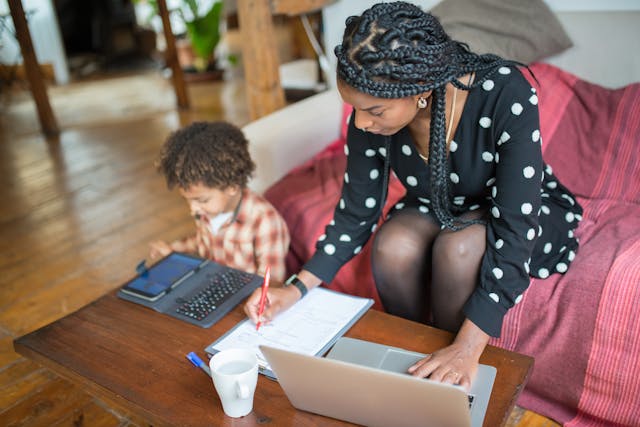
And for many parents, who are doing too much with too little help, screens can be a vital part of our modern parenting village.
Yes, there are valid concerns about screentime. I’m assuming if you’re reading this article, you already know about the screentime concerns—contributing to physical developmental delays, poor posture, behavioral and cognitive issues, social delays, etc.
(For the purposes of this article, we aren’t touching on social media usage—just television shows, apps and games.)
Unfettered access to anything will likely be harmful, since us humans need balance. And age-inappropriate content can harm, no matter where it comes from.
So, there are valid reasons to supervise and limit screentime. But let’s look at some of the benefits!
General screentime benefits.
Screen time has positive social benefits when used with friends or family. TV shows and films have incredible social value, and spending time in a communal event encourages bonding and belonging.
A local dad of one school-age kiddo, C.N. (who requested initials as identifier), said, “I was reading research on screens and three-year-old kids, and they compared three things: TV alone, TV with an adult pointing at the screen and adult instruction.”
The more engaged the adult, the more the child learned and retained. Many video games encourage critical thinking, creativity and problem solving.
Apps and shows can provide solid educational content, challenging and educating during times when a parent is unavailable. They can help children develop linguistic and literary skills. This is especially true in lower-income homes, where access to other types of learning tools or opportunities may be limited.
Screens can be used to actively engage in creation, such as videos, photography and other types of art. Art is immensely valuable and learning how to create technological art not only encourages many of the social, emotional and cognitive benefits of art; it also builds skillsets for future careers in a technological age.
And lastly, experiencing various stories, cultures and perspectives builds empathy and global awareness.
Specific benefits to neurodivergent kids.
Neurodivergent kids in particular can benefit from screentime. Many neurodivergent kids need a predictable environment to learn, and some TV shows or apps are perfect in letting the kiddo know exactly what to expect.
Screens can be emotionally regulating for neurodivergent kids by virtue of that same predictability. The sensory stimulation from shows can be tailored to each child’s needs by turning the volume down or choosing a low-stim show/app. These help a kiddo feel safe, which reduces their cortisol levels.
Being able to fixate on a special interest can also bring an element of calm to a child whose friends or family might not be interested in talking about the same subject or playing the same game over and over.
Screen time also gives a child a sense of control—they are the only ones involved, and they don’t have to navigate the complex emotional states of playmates, which can be confusing or dysregulating.
Lambasting screen time is discriminatory toward many families.
When we judge parents or kids for using screen time, we are criticizing families who don’t have an extended village—which let’s be real is many of us in America.
This judgment of “too much screen time” is often disproportionally used against working-class and poor families, disabled parents or even just parents with a rigid work schedule.
Many parents can’t just hire a sitter or take time off to provide screen-free childcare.
“Just send them outside” isn’t a guarantee either, if a family doesn’t have a safe outdoor place for a child to play unsupervised–or if the child is too young regardless.
It’s a privilege to have a fun fenced-in yard, to attend an after-school educational activity and to have a caregiver available to engage at all times.
C. N. says, “It makes sense that if someone has to work a job and can’t afford childcare they might lean on screen time. That’s an indictment of our current economic system—not a vote for screen time.” His kiddo watches a limited amount of TV; they especially use screens on long car rides.
RELATED: Protecting Kids From Online Scammers
Curated screen time is an easily supervised way for a child to be safe and engaged while a parent works or prepares dinner.
Screen time fills in the gaps for families without a village. Screen time is that second caregiver for many families, especially ones who are already experiencing inequities.
Since part of the drawback of screentime is that it displaces other “better” activities—like playing outside or being with family—if the child is already not playing outside or being with family (for example, they’re by themselves in the playroom because their parent is cooking dinner)—then the “displacement” concern may not be directly relevant.
C. N. notes, “We need something like France’s system at a bare minimum.” France, like many European countries, is far better at supporting working parents and families with economic, educational and healthcare policies.
So if your kiddo really likes screens and they watch a TV show or play a game every day, there’s no need to feel guilty about it!
As long as you’re supervising content to ensure it’s age-appropriate and still creating opportunities for lots of family play and bonding, it can even be a good thing if it helps support you to be a better parent.


