
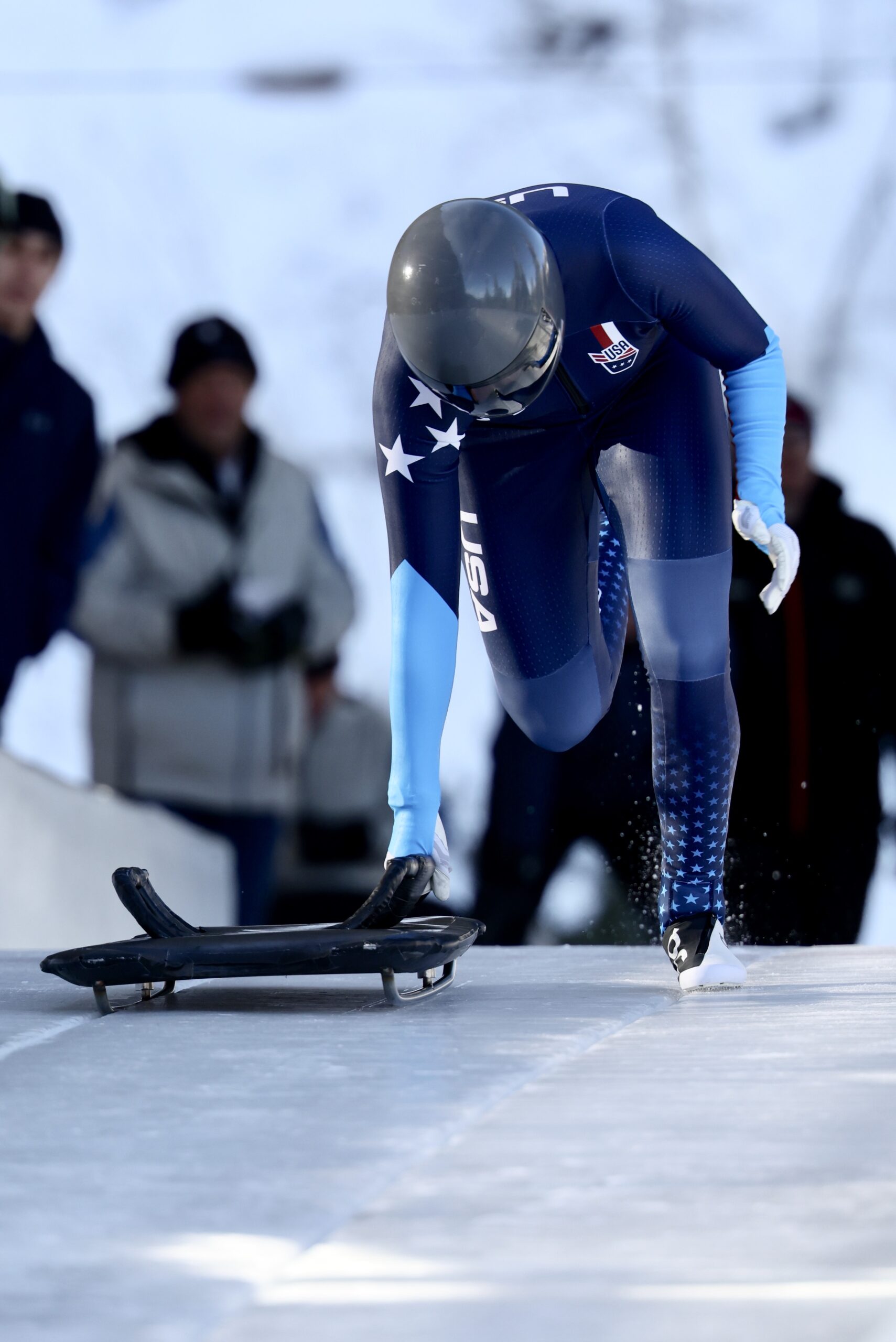
When Liesel Baker, from Saline, first saw bobsledding during the 2018 Winter Olympics, she had no idea it would lead her down a frozen track headfirst at 80 miles per hour.
“I originally was interested in bobsled after watching the 2018 Olympics,” she said, “but then I met Phil Harrington (a previous US slider) who owns a gym in Ypsilanti. I started training with him when I graduated college in 2019 and he convinced me to try skeleton instead.” After attending a one-week skeleton school in Utah in early 2020, Baker said, “Right away I knew it was something I wanted to pursue.”
Becoming a skeleton athlete
Like many athletes, Baker’s path was delayed by the pandemic, but by December 2021 she was in Park City, Utah, fully committed to learning the sport. The transition from her background in ice hockey and lacrosse wasn’t seamless, but it gave her the mental edge she needed.
“They helped me develop a great work ethic and taught me how to be persistent in pursuit of a goal,” she said. “There are going to be a lot of times in sports where you get cut from a team or do not get an opportunity you wanted, so learning how to weather that situation and keep going is a skill that hockey taught me from a young age.”
That perseverance is crucial in a sport where the start is as important as the finish. “The hardest skill for me to learn when I started and still to this day was the push,” Baker said. “Having not come from a sprinting background, this was an area I felt pretty behind in when I started, and I have had to put in a great deal of time and energy to try and develop.”
Focus and fear
The adrenaline rush of skeleton comes with its own mental challenges. “The fear from sliding fades over time,” Baker said, “but there will be a lot of times where I get nervous before a run… you only have to be brave long enough to walk to the line and convince yourself full speed ahead.”
Once she’s on the sled, she said, “There is this realization that I am getting down the hill one way or the other so I might as well make the best of it.”
Mental focus can make or break a race measured in hundredths of a second. “This is an extremely difficult aspect of any sport,” Baker said, “There is a lot of opportunity in skeleton to overthink and overanalyze, but when you step up to the line you have to be able to forget all the extra, know you are prepared, and keep it simple.”
RELATED: Young Folk Musician Performs at Local Events and Festivals
A strong support system
Behind Baker’s growing success is a network of unwavering support. “I could talk about my support system all day! They are my greatest advantage,” she said. “My family is unbelievable. They have taken on my goal as their own and have committed just as much of their lives to it as I have.”
Her workplace has been just as instrumental: “I work at the Kiwanis Thrift Sale in Ann Arbor, and without them, what I am doing now would not be possible. They host fundraisers for me, flex my schedule as I need, and most importantly, the other staff, volunteers and members are extremely supportive of what I am trying to accomplish.”
Learning, growing and looking forward
Baker finished seventh overall in her first North American Cup season—an impressive debut. “Honestly, my first reaction was I should have done better,” she said, “but then I did a lot of reevaluating and realized I need to improve my mindset and self-talk. Now, after a lot of convincing, I am proud of my turnout from last year.”
Looking ahead, she added, “I know I am capable of improving upon it this year, and I am excited to show myself that. I am excited to put myself in a good position going into the 2030 Olympic squad.”
Her experiences with Team USA Skeleton have been both challenging and rewarding. “It is very close in the sense that we are doing something many other people don’t understand,” Baker said. “It is also competitive, but my experience has only been healthy competition. I have been truly blessed to consistently get to train with sliders better than myself. They have taught me so much and pushed me to improve.”
Role models and success
When asked about her role models, Baker doesn’t hesitate: “My biggest role model is my mom. She is the hardest working person I know, and she is the person who instilled my work ethic in me.”
In sports, she looks to Tom Brady. “He is the model athlete for ‘hard work pays off.’ Nothing was given. He earned a spot at the bottom of the roster, took advantage of the opportunities he was given, and worked his way up to being the greatest of all time.”
As for what success means, Baker’s answer is grounded in gratitude. “I’ve recently realized that I am already succeeding,” she said. “I am extremely privileged where I get to spend every day working towards my dream which I don’t think a lot of people get to do. I genuinely enjoy getting the opportunity to train and get better, and I love the people this sport has allowed me to meet.”
Baker’s drive is matched by humility, family and purpose. “I believe I will always have an athletic, competitive outlet, and I will always make my family a top priority,” she said. Then, with a smile, she adds, “If I end up having a house full of dogs at some point too, that would be cool.”
To support Baker consider contributing to her gofundme site: gofundme.com/f/liesel-skeleton.


