
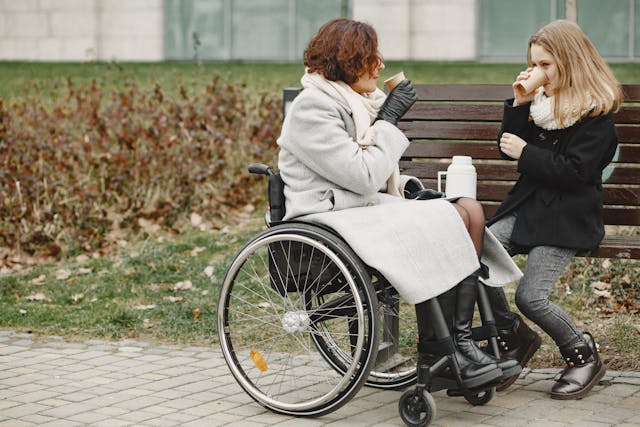
How I, as a disabled mom, will be teaching my daughter about disability.
Six years ago, I was diagnosed with a rare disease, Cushing’s disease. I have pituitary tumors that keep regrowing and cause hormonal imbalances. I’ve had surgery in the past to remove them, and will probably remove more in the future. I have ebbs and flows in how I’m feeling. I’m an ambulatory wheelchair user, which means I use it as needed instead of all the time. I also use canes, take daily medication and require monitoring.
The disabled community is incredible and I’m so proud to be a part of it. I have surrounded myself with similar people who have chronic illnesses and disabilities and found so much strength, kindness and love within the community. However, outside of it, I’ve experienced a lot of ableism. It’s really important to me that I raise a daughter who will be an ally to this community.
The first thing I plan to do is normalize differences. One of the biggest reasons for ableism is a lack of understanding. Showing these differences to my daughter early on will teach her that disability is everywhere. I also want disability to be seen in a positive light. It requires strength and courage, and that’s how I’ll explain it to her.
As she gets older, of course, I’ll get more specific. I can talk to her about inequality, the Americans with Disabilities Act and explain what microaggressions are and how to identify them. I can tell her about my own experiences with ableism, and bring her to protests. But while she’s still little, the best frame is that disability is normal.
RELATED: Inclusive Playgrounds in Ann Arbor
Embrace differences
I’ll explain to her that differences should never be looked down on or pitied. Some children might need medication or wheelchairs, or think and act differently than she does, but that’s what makes us all unique. And it would be an incredibly boring world if we were all the same.
I’ll also be encouraging questions, which is something I often do with children. I get questions a lot about why I’m in a wheelchair, or my cane, or even my medications. I love getting the opportunity to explain to children how it helps, using phrases like:
“My bones are a little weaker, so this helps me move when I can’t do it myself.”
“This pill helps my brain talk to different parts of my body to tell them to work properly.”
Children always respond well. Usually, it’s the parents who are uncomfortable. I’m not saying you should stop every disabled person on the street and ask a million questions, but also give disabled people autonomy to respond. We don’t need you to protect us from curious children.
Media
I also plan on introducing media that includes disabled individuals. There are many books out there that teach about disability, and I hope to watch shows and movies with disabled actors and characters with her. Since there aren’t as many out there as I’d like, I also plan on showing her limited amounts of social media. I follow amazing disabled comedians, activists, musicians and more.
Furthermore, there are many days dedicated to diseases and disabilities, which is a perfect starting point for education. I plan on having a calendar filled with these dates, such as World Down Syndrome Day, Rare Disease Day and even Cushing’s Disease Awareness Day. Starting the conversation and explaining something helps monumentally. Children are scared of things they don’t know, so make sure they know about disability.
As my daughter grows, our education will expand, but I’m excited to explore this world with her. I want to raise a kind, loving little human who accepts and stands up for everyone. Disability is just the start.


