
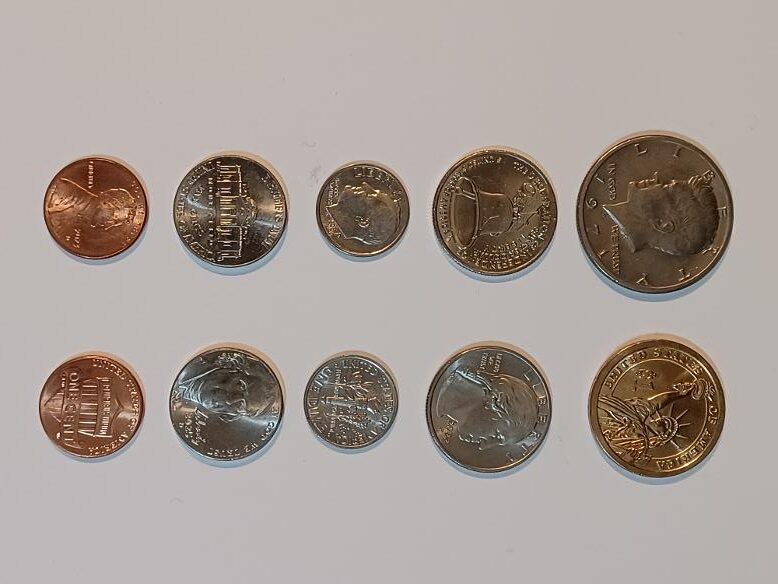
Are you looking for an affordable way to spend quality time with your family while having fun and learning something new? Coin collecting is an enjoyable and inexpensive way to learn about money and history!
You can start for free with pocket change. Sometimes, a circulating coin even contains a valuable error, so you might make some money too! The collector community is a knowledgeable, helpful and friendly group of regular people just like you.
Bored no more
How many times have you heard your kids or grandkids say, “I’m bored!” on a rainy day? Beat that boredom with a wholesome hobby for the entire family.
Coin collecting puts idle time to good use by helping children learn about money as well as the people and events appearing on money.
Why coins?
Analog entertainment provides time away from screens that may damage vision and shorten attention spans. Interacting with something in real life focuses the mind. The handling and inspection of coins uses sight and touch, providing a more meaningful multisensory experience, helping the mind build long-term memory!
Coins are easily obtained. An observant stroll through your neighborhood, Gallup Park, Briarwood Mall or the U of M campus will occasionally yield treasure. I found a dime outside my office building last week. The week before, I found a penny while walking to the parking garage. Last year, I found a quarter while pumping gas. It was just lying there, right by my foot, as if asking to be found and studied. Coins are everywhere, and if you pay attention, you can start your collection for free.
As I look at my end table, I see a few pennies, nickel, dimes and quarters. These coins tell compelling stories of American history. Why did Abraham Lincoln’s portrait first grace the front of the penny in 1909? Why did George Washington start appearing on quarters in 1932? Why did Thomas Jefferson first appear on the nickel in 1938? Why did Franklin Roosevelt begin appearing on dimes in 1946? The answers lie within our country’s history.
The many faces on coins
As the centennial anniversary of Abraham Lincoln’s 1809 birth approached, Theodore Roosevelt wanted to honor Lincoln by adding his image to a coin. As a man of humble beginnings, why not have our most common coin, the penny, bear his image? This decision set a precedent and began the process of having presidents appear on our coins.
In 1932, the country was in the grip of the Great Depression. Morale was low. What could be done to reinspire confidence among the struggling families? Remind them of their glorious past! George Washington was born in 1732. Along with Lincoln, the pair are consistently rated as our two best presidents. 1932 was the bicentennial of Washington’s birth. It was time to celebrate the birthday of the father of our country!
In 1938, Europe was on the brink of war. Everyone feared what would soon come. Who could we place on our coins to increase our confidence? Thomas Jefferson and with the bicentennial of his birth at hand, it was fitting to honor him.
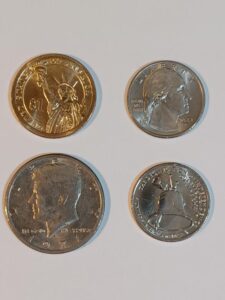
In 1945, as World War II showed signs of ending, Franklin Roosevelt died in Warm Springs, Georgia. Our longest serving president passed away while guiding us through one of our biggest challenges. It took a few months to organize, but in 1946 FDR’s portrait appeared on the dime. It was a suitable memorial. Everyone would see it daily. And the dime made the most sense as our fallen president was a champion of the March of Dimes.
In 1975, the United States Mint set another precedent by introducing a two-year circulating commemorative program with new designs on the back of the quarter, half dollar, and dollar to honor our nation’s bicentennial. A colonial drummer boy kept Washington company on the quarter. Philadelphia’s Independence Hall stood majestically of the reverse of Kennedy’s half dollar. And the Liberty Bell, superimposed over the Moon, supplemented Eisenhower’s dollar coin. I still get a bicentennial quarter in my change every few years! It is always a delight.
In 1999, the U.S. Mint reinvigorated its circulating commemorative idea when it introduced the 50 State Quarters program. Other themes have since graced the surfaces of the penny, nickel, quarter, and dollar. In 2026, additional coin designs appeared on dimes, quarters, half dollars, and dollars to celebrate the nation’s 250th birthday.
What else coins teach us
Pennies are great for learning to count. This is good for young children, ages 3-5. Counting with objects in hand makes the concept of numbers feel real, not conceptual.
Nickels, dimes, and quarters are excellent for skip counting during ages 6-8. Learning what things cost helps children ages 9-11 understand what their allowance enables them to purchase and the labor that went into earning their allowance!
Children ages 12-14 can grasp the relationship between coins and paper money. Both topics fall under the larger field of numismatics which also includes tokens and medals. When your kids or grandkids are with you at the store, have them pay with paper money and calculate what their change will be and what quantity of coins and bills it may come in. It is great practice! Young adults, ages 15-17, can learn where and how coins are made and the metals they contain. Adults can learn about the metallurgy of coin alloys as well as the laws specifying coin details and the legal restrictions of their manufacture.
Where to get help
“Buy the book before you buy the coin” is timeless advice. And, if you are on a budget, borrow the book from the Ann Arbor District Library! When I searched the AADL website today it showed that both “A Handbook of United States Coins” (a.k.a. “The Blue Book”) and a recent edition of “A Guide Book of United States Coins “(a.k.a. “The Red Book”) were on the shelf at the downtown library as Call Number 737.49 Ye, and available for a 4-week checkout! I suggest studying both, red first, then blue.
Coin clubs and shows offer camaraderie and education for free or nearly free. Livonia, Royal Oak, and Wyandotte have regular meetings. The big shows are the Michigan State Numismatic Society Spring and Fall Conventions in April and November. I highly recommend attending the shows and obtaining MSNS membership!
RELATED: 7 Ways to Connect with Grandparents – Long Distance
Coin shops are profit-seeking businesses. Sometimes, a kind owner may show extra consideration to a family with young children that are just getting started. I recommend shopping around before buying, especially for larger purchases. And buying online is too risky for beginners! A place to start could be Old Towne Coin & Gold in Ypsilanti. They will advise parents and grandparents on coin investments as well as help kids build a coin collection from their inventory. A little further away is Garden City Jewelry & Coin which also caters to investors as well as collectors. Their sister store, Novi Jewelry & Coin, carries similar items. All three stores are open on Saturdays!
Local banks and credit unions often have many coins available. You can regularly get rolls of pennies, nickels, dimes, and quarters, all at face value. Maybe even a stray half dollar or dollar too! The Bank of Ann Arbor has three Ann Arbor locations with lobby and drive-up hours, including Saturday mornings. The University of Michigan Credit Union has eleven Ann Arbor locations, five of which have Saturday hours. Search some coin rolls for hidden gems!
Preserving your coins
Loose coins can get misplaced, and coins stored in a box can cause unsightly scratches that damage value as well as appearance. Several proper storage products are available. A major supplier is Whitman. They have cardboard 2” x 2” flips in all sizes. A favorite of the entry-level collector! I remember using these as a child. They also have tubes, foldout albums, and much more. No matter your choice, be sure to avoid polyvinyl chloride (PVC) as it will leave green sticky slime on the coin.
Starting coin collecting young
My parents started me on my coin collection when I was 10 years old! I remember my dad letting me go through his pocket change when he came home from work. My mom used to take me to the bookstore around my birthday to buy a coin magazine or book.
Who could you share a coin collection with? Maybe you can make a new friend at a coin shop or convention? Get started today! Spending quality time on a hobby with people you love is a great feeling.


