
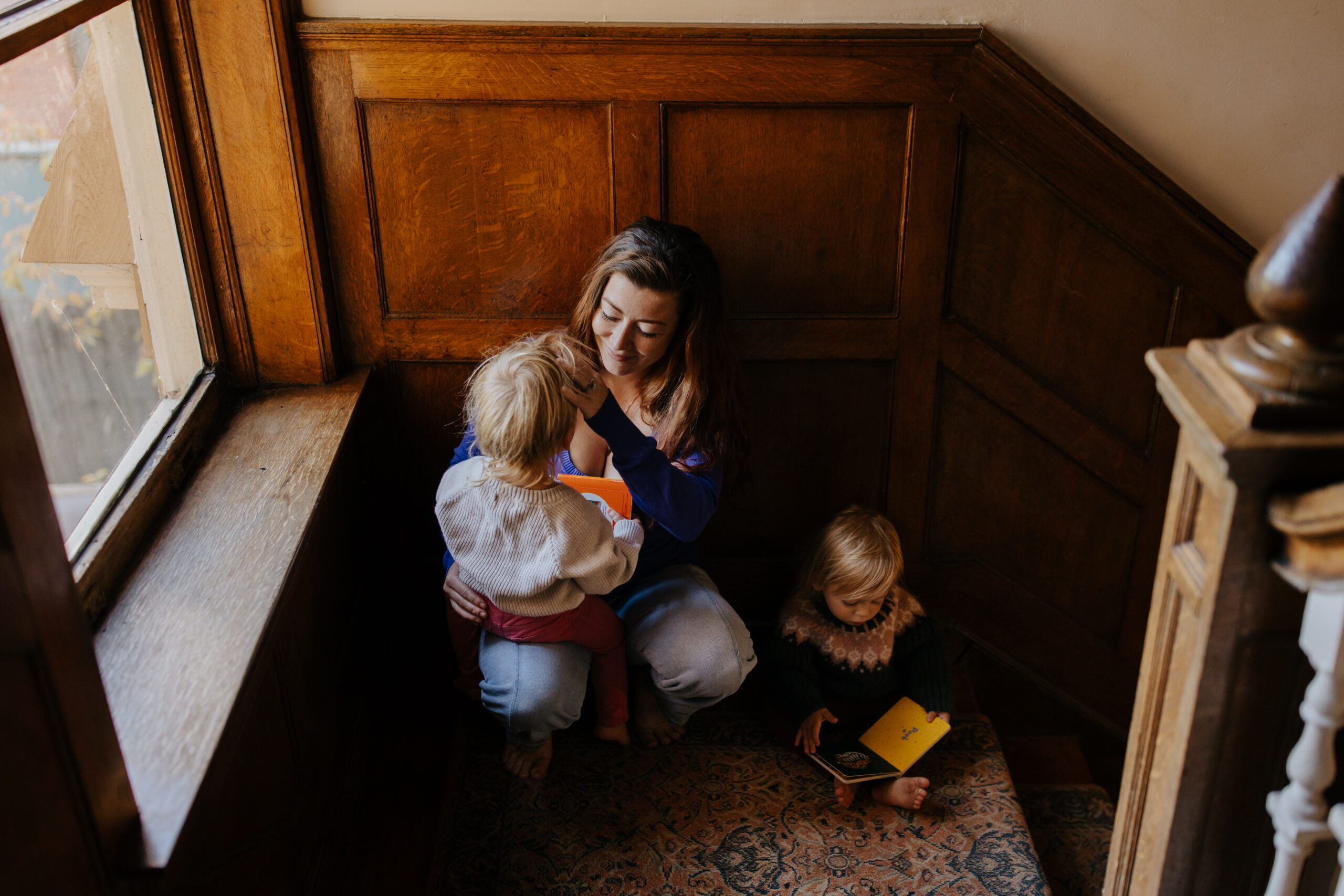
At the birthday party for one of our friends, I turned to see one of my triplet two-year-olds grabbing a chip from the table and instantly my heart rate soared. I rushed over, holding out my hand for the chip. “Here, Mama has to check and make sure it’s safe to eat.”
I squinted at the chip. It looked like a tortilla chip, which would usually mean it’s gluten-free, but “just looking like it” wasn’t good enough. It was never good enough. While my child complained about the chip being taken away, I wearily tracked down one of the hosts to ask about the ingredients in the chip, which took us on a side quest to the kitchen to find the chip bag because—as is common with most people without food allergies—they hadn’t read the ingredients label when they purchased it.
It was indeed a gluten-free tortilla chip.
I breathed a sign of relief at avoiding a rush to the bathroom (to scrub my hands after touching gluten) and gave the chip back to my child.
All that labor, just to have a chip at a party.
I have celiac disease, an autoimmune disorder where even the smallest ingestion of gluten sets off the immune system to attack the small intestine’s lining, leading to short-term symptoms like intense gastrointestinal distress and fatigue, and longterm symptoms like a weakened immune system, anemia, vitamin deficiencies and heightened risk for some cancers.
Because my children are genetically related to me, they have a 1/10 chance of developing celiac disease, rather than a 1/100 chance like the general population. Some food allergies also have a genetic component.
I take this genetic risk very seriously.
After years of unexplained illness on my part, my diagnosis brought clarity, and completely reshaped the way I eat, plan, and move through the world.
RELATED: May Is Celiac Disease Awareness Month – What Is Celiac and What Can You Do?
But parenthood has brought a new layer: watching my child for symptoms, making medical decisions about their diet, and preparing them for the possibility of a disease that I hope they never face.
There isn’t a lot of firm advice on how to raise children who are at risk for celiac disease. There’s a lot of advice on how to raise kids with celiac: adhere to a strict gluten -free diet. There’s a lot of advice on raising kids with no intolerances: don’t eat gluten-free, because you’re at risk of missing out on nutrients to your diet if you only eat gluten-free.
But my children are in an inbetween space.
My family has made the decision to keep the children gluten-free, for their safety and mine.
Celiac disease is so sensitive that, if the kiddos ate goldfish, carefully washed their hands, but still had a crumb somewhere on their body or clothes, that would be enough to expose me and trigger my body’s immune response to attack itself.
This is something that any parent with a food allergy or sensitive intolerance can relate to.
Once, I ordered gluten-free chicken from a restaurant. The ingredients were entirely gluten-free. But it was cooked in the same fryer as other glutenous dishes at the restaurant—and that simple cross-contamination exposure was enough to sicken me for days, with vomiting and diarrhea and foggy fatigue.
For the kiddos’ benefit, the latest data available indicates that if a child doesn’t ingest gluten, they can’t develop celiac disease. That even if they have the celiac gene from me, if they maintain a gluten-free diet all their life, they won’t be at risk for developing celiac.
Whereas if they ate gluten, there could be a point where an environmental trigger (like an illness, severe stress, or a major life event) would turn on the celiac gene and they would be disabled like me.
This may seem like a no-brainer, but there’s a major difference between a gluten-free diet and a celiac safe gluten-free diet.
This difference is the same for many children and people with allergies as opposed to intolerances.
A gluten-free person can eat the chicken that’s fried in the same fryer; a celiac or allergic person usually can’t. A gluten-free person can eat at a restaurant or friend’s home that makes gluten-free dishes in a shared workspace; a celiac person often needs the restaurant or friend’s home to have a separate dedicated gluten-free space (which most don’t). A gluten-free person can buy any gluten-free food at the store; a celiac person often can only buy foods that are tested and certified gluten-free by a third party source.
It’s the difference between a gluten-free person just picking the croutons off their salad, and a celiac person unable to even eat a totally gluten-free salad because it’s made in a kitchen where glutenous foods are made.
Although eating gluten-free is limiting, it’s far less limiting than if you have celiac disease.
Some people have said to me that it’s unethical of me to have children when I have a disability with a known genetic component that I may pass on to them.
There’s a lot of ableism tied up in that statement, from harmful stereotypes to infantilization to viewing disabled lives as worth less.
I take my disability very seriously and did consider, before having children, whether it was ethical to risk my genetic disease in future children—knowing that my children would fully have the right to come to me someday and be upset about the life and body I’ve given them.
Could I answer my future children’s potential questions with a clear conscience? I ultimately decided yes. I also get to let the soft animal of my body love what I love, and I wanted to love my children.
Besides the problematic viewpoints tangled in the belief that disabled people shouldn’t have kids, there’s never been an easier time to live with the disability of celiac or other food allergies. Multiple gluten-free and allergen-free organizations test and certify food; most cities have a restaurant or more with an allergen-trained chefs who can make safe food. And as long as my children stay on a gluten-free diet, they’ll never develop the debilitating symptoms of celiac disease.
If you are a gluten free parent, or a vegetarian, vegan, dairy-free, etc parent, there are some fantastic restaurants in Ann Arbor that provide allergen-friendly meals or goodies. Some of them are great at avoiding cross contamination; some do warn you they have cross contamination.
Some restaurants to check out are Frita Batidos, Anna’s House, Tios, La Taqueria, Sava’s, Sat Springs Brewery, Slurping Turtle, TeaHaus and Totoro. Always call ahead with your specific allergy and see if they can accommodate.
Chronic illness absolutely affects our entire household. Even if my children weren’t gluten-free for their own health, they would need to be gluten-free at home for mine. The danger of having gluten in my own home is just too great. I can’t even share a sponge that’s scrubbed out glutenous pans, let alone share a kiss or hold hands with my child if they’ve just eaten gluten.
My partners learned to read labels at the grocery store of everything they buy, and how to ascertain the “sneaky” ingredients that often slip miniscule amounts of the allergen into a food or condiment without calling it by name. They gave up keeping some of their favorite snacks in the house in order to be entirely safe for me.
Food allergies are also incredibly isolating. I can’t go to dinner at anyone’s house and actually eat the food they’ve prepared. I can only meet friends at very specific, safe restaurants. And as understanding as most people are of food restrictions, people like sharing food they make. They like inviting you to their favorite restaurant. It’s an unavoidable but definite barrier when it comes to bonding with other people.
It gets worse when people know I’m gluten-free and excitedly make something gluten-free for me to eat, but I still have to reject it. Cooking “gluten-free” is different than reading ingredient labels and making sure everything is certified; and it’s very different than scrubbing down your entire cooking space, avoiding using wood or colanders (which can’t be safely deglutened), and making sure no one did any glutenous baking in the last 24 hours. When people put in effort to do something they think you’ll be able to eat, and you still reject it, they naturally feel put off or even offended. Which doesn’t do much for community bonding either.
Prior to parenthood, eating the food that my body was allergic to meant days of agony. But now with kids, being glutened means somehow still functioning as a parent and caring for my little ones while suffering intense pain and GI distress—essentially, every time I eat something feels like risking getting a nasty multi-day stomach virus and still having to care for kiddos. The stakes are far higher.
Parenting in the shadow of celiac disease means constant vigilance, constant anxiety, constant scrutiny of everything I and my children ingest. But it also means raising children who are very aware; who understand their bodies have natural limitations, and that’s okay.
As my children age, they will be the ones responsible for determining if they’ll eat gluten or not and risk celiac disease. Ultimately, I can’t control if they develop celiac or not. But I can control how supported they’ll be by their family if they do. And in my gluten-free household, they’ll always have a safe place to eat.


