
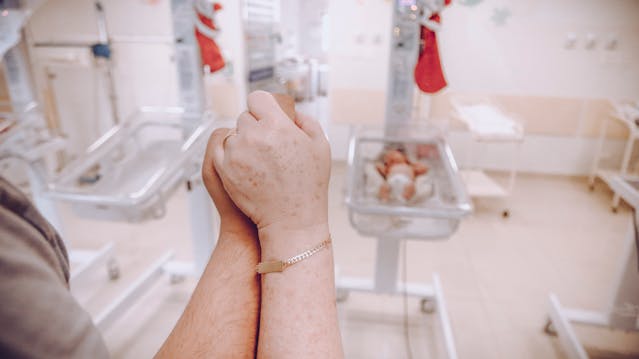
Leaving the hospital as a NICU mom can be daunting. You think that your life is going to just be newborn bliss, but there is so much more to manage.
My little girl went home with a feeding tube and oxygen, and many consider that to be pretty light. Many preemies go home with more complications. Based on my experience, here is a look into what life might be like after the NICU at the University of Michigan.
Feeding
To get off the feeding tube, we work with a dietician. We met with them once a week, and they were our favorite team. They worked to help my daughter off her tube, and then on eating in general. In order to take the NG tube out, your NICU baby needs to be taking 80% of their feeds by mouth. The dietician will stay with you after to make sure that your baby is gaining weight.
We had different tricks to support our little one. She had fortified breast milk, which meant that she had breast milk mixed with formula to make it 26 calories, which we brought down to 24 calories. We also added avocado oil to her bottles (a very small amount) to give her something calorie dense without adding a large amount of breast milk, especially since our munchkin spits up a lot.
Ophthalmology
You’ll follow up on ROP exams as well, which stand for Retinopathy of Prematurity. Tiny babies have blood vessels in their eyes that haven’t fully reached where they should. There are two aspects of this. One is stages. Our baby was at stage zero, which means no intervention was needed for her eyesight, but higher stages could need laser treatment or surgery.
There are also zones. You want to have the vessels in stage three, which is more spread out, versus stage one is more center in the eye. These are every two weeks from 34 weeks on, and can happen post discharge. Ours lasted until 45 weeks, and many go to 48. They numb your baby’s eyes and check behind with a light, and it can really upset your little one because they aren’t used to the light or dilation. But they are a necessary evil, and they keep your baby from having blindness issues.
RELATED: Resources for Disabled Children in Washtenaw County
Pulmonology
If your child goes home on oxygen or has any lung issues, they’ll connect with pulmonology. Our daughter went home on a quarter liter. They didn’t want to see us until three months originally, but since she was doing so well we were able to push it to six weeks post discharge. She had a small test in the office, and she was able to slowly wean off oxygen. Every two weeks, you add two hours, but split it up. For example two hours off oxygen twice a day for four hours total.
Then, once your child is off during the day, they’ll do a night study, usually around six months of age. Then if they pass it, you get to graduate from oxygen. If not, your munchkin will remain on it for a bit longer, and then try again when their lungs have grown. They also might give you an inhaler that helps expand your child’s lungs.
Visiting nurse
We had a visiting nurse come twice a week in the beginning, and eventually this became once a week. She was there to address any issues, but she also weighed our daughter every week and communicated with our pediatrician and dietician about any issues. So she would report when the weight loss wasn’t where it should be, and when we had a worry that our baby had thrush, she made an emergency appointment with our pediatrician for us.
This was our most consistent care, and we loved having this and knowing our daughter would be okay.
Early-On
Because your child is premature, they can qualify for Early On. Our daughter was born at 27 weeks, which is considered extremely immature, so not every single child is able to qualify, but if you can, it’s an awesome service. They send someone for an initial assessment and stay with your child until age three. Since premature children can be behind on milestones, they will work with you to help your child succeed, reach milestones, and get help wherever they need it. And, amazingly, this service is 100% free.
Specialists + Pediatricians
Each baby leaves with different specialists. For us, our daughter has a hole in her heart, so we’re in touch with cardiology. The hospital sets up an initial appointment, and then you go from there.
Our last follow up is with our pediatrician. We saw her right away after discharge, and since we have so many doctors, they mostly did measurements, sick days, and vaccinations for the first six months of her life.
It can be daunting to juggle all of this, but they truly make it as easy as possible. The weekly appointments are usually virtual, Early-On comes to your house, and you can pick your own pediatrician to make sure they are close by. If you’re looking at a discharge soon, know that so many people have your back.


