
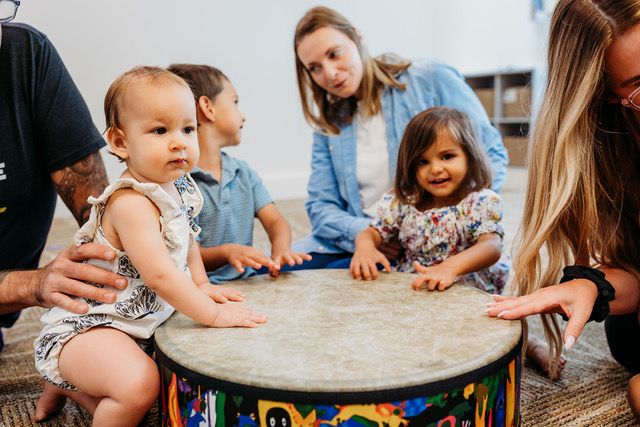
Most parents have witnessed a fussy baby calmed by a lullaby, a toddler who can’t resist bouncing to a beat, or a preschooler inventing songs with hilarious lyrics. But beyond the joy and entertainment, there’s something remarkable happening inside those little brains. Music isn’t just fun. It’s foundational to how children learn, think, and grow.
The Science of Sound: How Music Builds Better Brains
Recent research confirms what parents have long suspected: Music is a powerful tool for cognitive development.
A comprehensive meta-analysis published in Frontiers in Psychology analyzed 46 studies involving 3,530 children and found that musical training significantly enhances executive function. These are the mental skills that help children plan, focus, remember instructions, and juggle multiple tasks. These are the very abilities that underpin success in school, emotional regulation, and social navigation.
The longitudinal evidence is equally compelling. A study drawing on data from one of the largest long-term investigations of brain development found that kids who consistently engaged in music training scored higher on multiple cognitive and language tasks. Remarkably, the study also revealed music’s power as an equalizer: Musicians across all socioeconomic backgrounds demonstrated similar gains, suggesting that music training serves as a “cognitive enrichment tool” that transcends economic circumstances.
Even the youngest children benefit. In a randomized controlled trial of three-year-olds, children who participated in music programs developed greater neural efficiency. Brain imaging showed that they didn’t have to work as hard to achieve the same results as their peers, a finding that speaks to music’s ability to literally streamline how the brain processes information.
Why children are natural musicians
So why does music feel so instinctive to children? The answer is biological. Research on musical ability has found that children’s musical abilities continue to improve without formal training until around age 12. This natural development is closely tied to the brain’s capacity to hold and process sounds, even in young children.
Beloved children’s musician Raffi captures this beautifully: “The first instrument the child is hearing is a parental, loving, caring voice. That feeling of being loved for who I am – being safe in my mama’s and papa’s arms – that feeling, that’s the first music.”
Because music activates multiple sensory channels simultaneously, it naturally engages the developing brain in ways that feel like play. And as developmental experts have long noted, play is how children learn best. When music feels like play, children aren’t just having fun. They’re building neural pathways that will serve them for life.
Long-term benefits
The benefits of music aren’t fleeting. They compound over time. A landmark twelve-year study on children receiving music lessons found that making music physically changed the brain, regardless of natural talent. The more music the children played, the greater the activation of key brain regions.
Anne-Marie Seither-Preisler, author of the study, noted, “It is advisable to give every child an initially playful approach to music. After all, making music and singing is an investment in the perception of the world that surrounds us. Later cognitive abilities are largely based on the ability to perceive our world in a differentiated sensory way.”
Practical Tips for Music at Home
All of this science is encouraging, but it can also feel daunting. Some parents assume they need formal training, a natural ear, or expensive instruments to expose their child to music. This isn’t the case. The beauty of music is that it’s already woven into the fabric of daily life. You just need to know how to spot the opportunities.
Here’s how to weave music into your family’s life:
1. Show Them With Your Actions
Modeling musicking as parents is key. When children see the adults in their lives enjoying music, they learn how to joyfully incorporate music into their own lives. This includes singing along to the radio, tapping a beat while cooking, or dancing in the kitchen. Your enthusiasm is more contagious than any lesson.
2. Try Simple Activities
The most powerful musical moments are often the simplest. No sheet music required. Try these:
- Kitchen Band Jam: Pull out pots, pans, wooden spoons, and sealed jars. Tap, bang, and scrape to discover different sounds. Try a rhythm circle where one person sets a beat, and everyone follows.
- Freeze Dance: Play upbeat music and dance. When the music stops, everyone freezes. This builds listening skills, self-control, and body awareness. Better yet, giggles usually follow.
- Body Percussion: Clap hands, snap fingers, stomp feet, or pat knees. Start with simple patterns and have children echo them back, then switch roles.
- Sound Sorting: Gather everyday objects (keys, bells, paper, spoons) and explore how each sounds. Sort by loud/quiet, high/low, or long/short. Hide an object behind your back and let children identify it by sound alone.
- Nature’s Music Walk: Step outside and listen. Record sounds like birds, wind rustling, and leaves crunching, then play them back as a “sound quiz.”
3. Make It a Ritual
Establish designated music time, whether a weekly Family Music Night where everyone shares a favorite song or a daily dance break after dinner. These rituals create lasting memories and signal that music matters in your family. Not as a chore, but as a shared joy.
A gift that lasts a lifetime
The research is clear: music builds brains. But perhaps more importantly, music builds connection. Whether you’re singing in the kitchen, dancing in the living room, or simply pausing to listen to the birds outside, you’re offering your child something precious: the chance to grow, learn, and thrive through the miracle of music.
The 5-Minute Music Break
Here are some short activities that require zero prep and are perfect for busy families:
1.Echo Me: Clap or sing a pattern. Your child repeats it back. Increase complexity each round.
2.Song Swap: Each family member picks a song to play. Then everyone guesses why they chose it.
3.Mood Music: Play 30 seconds of different genres (classical, jazz, rock, lullaby). Ask: What does this music make you feel?
4.Name That Tune: Hum or clap the rhythm of a familiar song and see who guesses first.
5.Bedtime Wind-Down: End the day with one slow, quiet song.
Q&A about the benefits of music with Robin Robinson Director, Robinsongs For Kids
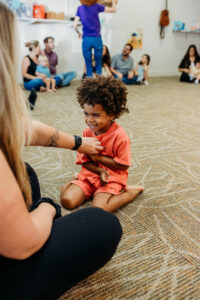
What changes do you notice in children after they’ve been taking classes for a while?
One of the most exciting things is seeing children begin to make the music their own. A child who spends the first few weeks quietly watching might suddenly start singing a song at home, moving to the beat, or playing “Music Together teacher” with their stuffed toys. Over time, we see children grow in confidence as music becomes another way for them to express themselves and connect with the people around them. Because the Music Together approach is grounded in research on how young children learn best, all of this development happens naturally through play, exploration, and participation.
Are there certain developmental milestones or skills that music seems to support?
Absolutely. First and foremost, Music Together supports children’s music development, giving them the foundation to become confident, lifelong music-makers. Over time, children learn to sing in tune, keep a steady beat and express themselves musically. But the benefits extend well beyond music. Singing supports language and early literacy; rhythm and movement support physical and motor development; and making music with others gives children opportunities to practice social-emotional skills like turn-taking, self-regulation, cooperation and confidence. That’s why we say Music Learning Supports All Learning®—as children grow musically, they’re also building skills that support their development across learning domains.
If you could tell every parent one thing about music and child development, what would it be?
You don’t have to be a musician to give your child the benefits of music. Young children learn through the people they love, so simply singing, dancing and playing with music gives them the kind of rich musical environment they need. Just as children learn language by hearing us talk and talking with us, their music development grows through regular exposure, experimentation and musical play.
What does music give children that other activities can’t?
Music is unique because it engages so many areas of the brain at once. When children sing, dance and play musically with the grownups they love, they’re developing music skills while also supporting language, cognitive, social-emotional and physical development. Few experiences give young children the opportunity to exercise so many parts of their developing brains at the same time—and to do it through joyful connection with the people they love.


