
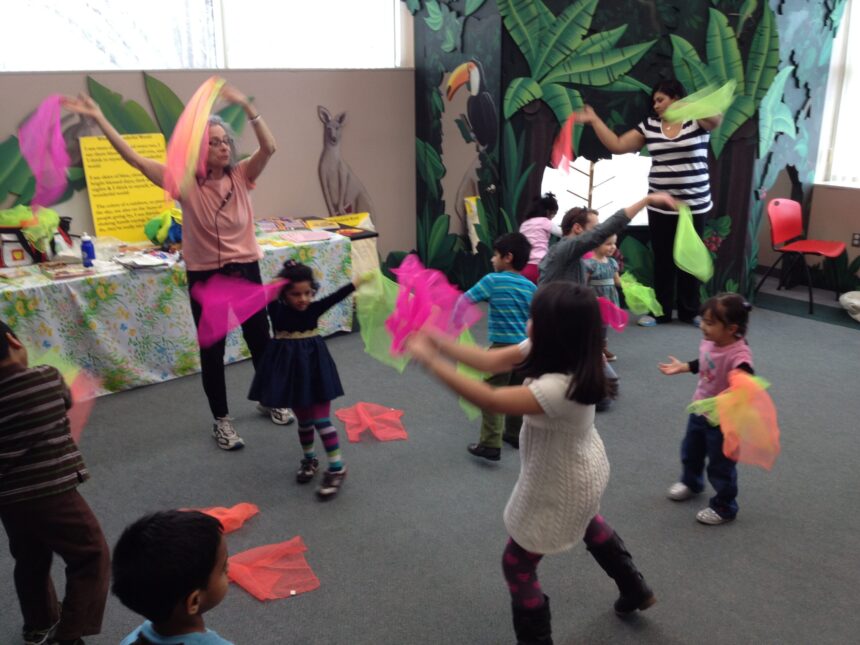
For decades, Music for Little Folks founder Gari Stein has inspired families with her joyful, movement-based early childhood music programming—rooted in deep intention, love and connection. Stein shares how the program originated, the values that underpin her work, and why music continues to be a transformative force for children, caregivers, and communities alike.
A Natural Fit: Teaching and the birth of a mission
“I always wanted to teach and work with the little ones,” Gari Stein said. “As a substitute teacher, I only accepted Kindergarten assignments. Along the way, I found the field of infant mental health—and that was it. A chance to combine my love of music and dance and learn the psychology of it all. A natural fit.”
Stein’s journey began early. “As a young child, I held dance classes in our basement. I had a big blackboard in my bedroom where I spent hours making seating charts and tending my class,” she said.
Her deep-seated love for education led her, over many years and college courses, to eventually graduate and step fully into her role as an educator and advocate for early childhood learning through music.
From singing in classrooms to founding music for little folks
Upon moving to Ann Arbor, Stein accepted a position to create a toddler program at a local preschool. What began as singing with children during the school day blossomed into a larger vision.
“I found myself singing with all the rooms, a song for every occasion—including one in the bathroom,” she said. “One day a fellow teacher gave me a jab and said, ‘You could do that.’ So I did, and thus Music for Little Folks was born.”
What set her program apart was not just the songs but the sense of emotional depth and community it fostered.
“I wanted my program to be more than just singing songs. I wanted to achieve connection through partner and circle activities. A simple song can turn cranky to calm,” she said. “I always ended with a lullaby. Children cuddled in rocking arms or rocking their dollies.”
Music as a tool for healing and growth
Stein believes deeply in music, especially in the richness of traditional folk music, as a fundamental human need and an essential educational tool.
“All children have the potential to be musical,” she said. “Music is available to everyone, at little or no cost and in an instant can bring people together. A simple song can bring calm and connection, strengthen social and emotional well-being, nurture our brains. One participant told me that our time together reminded her that there is still peace and calm in the world—that’s the power of music.”
Her understanding of music’s potential goes beyond entertainment—it’s about nurturing human development.
“I learned that a lot more is going on than the music. A lot of parenting. One of my goals was to help the grown-ups be confident and comfortable using music,” Stein said. “Often, they expected to sit back and watch. I was surprised to see how often folks struggled with moving, even in the simplest of ways.”
Over time, she encouraged caregivers to let go of judgment and self-consciousness, and to let their children “just be.”
“There was peace in the valley,” she adds. “One of the hardest lessons to learn was not laughing at the children.”
Moments that matter
For Stein, the highlights of her career have always centered around connection and community.
“I loved being out in the community, traveling to state agencies, creating programming for families—always a thrill. Visiting libraries and connecting with families in the Midwest and beyond—joy, joy, joy,” she said.
She fondly remembers creating and leading the Ann Arbor Symphony Orchestra’s Kinder Concerts—introducing classical music to young children through song and movement.
“Meeting and connecting with teachers and caregivers at conferences, workshops and keynotes, folks laughing at my jokes… And returning families with additional siblings, being recognized on the street with the passing years. It remains the fullest my heart has ever been.”
Her music curriculum was even sold internationally—something she calls “a thrill, an honor, and a privilege to work with so, so many wonderful people.”
Teaching, trust and timeless lessons
Stein’s approach to teaching is grounded in acceptance and joy, especially for those working with young children.
RELATED: Meet the Ypsilanti International Elementary School Principal: Dr. Cassandra Sheriff
“My advice to early childhood professionals has always been, ‘Just DO it,’” she said. “It’s not how you sing, but that you sing! No one cares if you have a great voice, or if your arms jiggle-jiggle, or if you’re not a great dancer. Nothing better than just doing it.”
She emphasizes the importance of being present and vulnerable, encouraging adults to learn and grow alongside the children.
“I get inspired just looking at the children and their families,” she said. “Every class or workshop with the faces inspires me. I am always eager to discover something new.”
Why this work matters
When asked to reflect on the meaning behind her decades of work, Stein offers several moving stories.
“One mom called me to let me know her son had terminal cancer and wouldn’t be returning,” she said. “By the end of our conversation, she decided to continue as long as possible. Beautiful moments filled the rest of the session.”
She continued, “I’ve had new moms—lonely and isolated—speaking different languages, far from home. Class was a gateway to friendships and playdates. Years later, many still get together.”
Her love for the families she’s served continues to be her guiding light.
“After all these years, I am continually delighted by the children and the grown-ups who love them,” she says. “I still am surprised by grown-ups who are uncomfortable moving and still think children are born saying, ‘I want to learn my letters and numbers, colors and shapes.’ Children were born to play—unstructured play—and that is how they learn.”
A lullaby for all ages
Stein’s signature style includes ending every session with a lullaby—something she sees as universal and ageless.
“You are never too old for a lullaby. I told this to my granddaughter, and she replied, ‘Not if you’re an old peace person.’ That I am!” she said.
Her motto, one that captures the spirit of her life’s work, is simple:
“When all else fails, try singing (and dancing). It really works.”
Gari Stein is the author of “The More We Get Together: Nurturing Relationships Through Music, Play, Books and Art.”


