
Since 1975, Washtenaw Intermediate School District (WISD)’s High Point School has been serving students with disabilities. It is a public school which originally admitted individuals who had been living in mental health institutions. Today, the school provides a range of specialized supports for students with various disabilities.
High Point School’s mission is to “provide an inclusive learning community designed to empower students.”
High Point School serves students ages 3-26 with severe cognitive, physical and multiple disabilities from across nine public school districts in Washtenaw County who meet specific evaluation criteria and are referred by their local school districts. Currently, 85 students are enrolled, across 15 different classrooms. The diagnostic breakdown include 36.5% autism spectrum disorder, 14% deaf & hard of hearing (DHH), 20% spinal cord injury (SCI) and 29.5% severe multiple impairment (SXI).
Program structure
High Point School is comprised of five different programs that serve ages birth to 26:
- WISD Student Programs
-
- High Point Program for students with severe multiple impairments (SXI) and severe cognitive impairments (SCI)
- Deaf and Hard of Hearing (DHH) program for K-8 students
- Autism Spectrum Disorder (ASD) program
- Honey Creek Community School: A K-8 charter school authorized by WISD that enrolls typically developing students and students with disabilities
- Gretchen’s House: A private early childhood center with an early head start classroom through WISD’s early childhood department
RELATED: Autism Friendly Preschools in the Ann Arbor Area
Clinical snapshot
High Point School offers several clinical supports for its students. We connected with an occupational therapist, speech & language pathologist (SLP) and physical therapist currently employed with High Point School to learn more about their programming and favorite part of working at High Point School.
Occupational Therapy
 Jason Ferrise, OTR/L
Title: Occupational Therapist (OT)
Years at High Point: 6 years. Starting my 7th year in October of 2026
Can you describe what supports you offer students? Within the school/educational setting here at High Point, Occupational Therapists support students through gross motor, fine motor, visual motor and sensory motor skills. We are also able to address sensory regulation, emotional regulation, sensory diets, ADL skills (activities of daily living), IADL skills (independent activities of daily living) and (feeding and swallowing skills paired with speech therapists).
We are able to provide classroom support for seating and positioning, as well as adapted approaches to extracurricular classes such as music, art and physical education classes. The OTs here at High Point are able to modify and adapt classroom environments to allow full functional participation with all educational material. We are also able to assist our aquatics instructor in the pool for best positioning for motor movement and comfort while in the water. Furthermore, the OTs are able to address job skills and life skills through our Life Skills classroom. (Typically, this is addressed through a multidisciplinary team approach with PT, OT, Speech, Teacher, Social Work, Teaching Consultant, Teaching Assistants, etc.)
Can you describe a typical day for you? My day starts with welcoming students when buses arrive at 8:20 AM. I assist with helping students get to class, as well as assisting the classroom staff begin their day with the students. Once students are settled, I attend to any students that receive direct occupational therapy services. This is provided either by “push in” or “pull out” style of service delivery. If the student’s therapy session is provided by a “push in” method, the session will either be directed towards their OT goals or by addressing the current class room instruction period as it relates to fine motor, gross motor, sensory motor, sensory regulation type of skills etc. If the session is a “pull out” delivery, the student and I walk to the desired treatment space and conduct a session that is geared towards their OT goals. After treatment sessions, I remain in the classrooms and surrounding spaces lending assistance, consultation and any potential modifications/adaptions as needed. I assist with sensory and emotional regulation as well as any behavioral support so that students are provided the support they need in the moment.
Speech Therapy
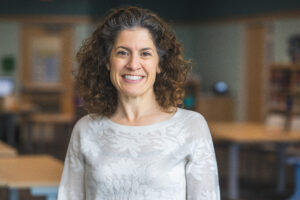 Rebecca Ankeney, MA, CCC-SLP
Title: Speech-Language Pathologist (SLP)
Years at High Point: 4 years
Can you describe what supports you offer students? Many of our students at High Point are non-speaking or cannot fully express themselves with speech. The SLP team works to provide augmentative forms of communication for them, often in the form of assistive technology such as iPads or computers with communication apps. We also consider what supports students might need to understand the language around them and how to best access their curriculum.
Can you describe a typical day for you? On a typical day, I start my morning in an SXI (severely multiply impaired) classroom helping to set up communication equipment for students to use throughout their day. Several of these students use eye gaze computers, which need to be mounted and carefully positioned for best use. I stay and support students and staff during their morning meeting. Then, I pull students out for individual therapy to work on their specific IEP (individualized education plan) goals. In the afternoon, I head to my ASD (autism spectrum disorder) classroom and run a speech group activity. These group activities allow me to teach the classroom staff best communication partner strategies and we play a game together to practice those strategies. We have a lot of fun learning together. In the late afternoon as students prepare to go home, I do paperwork such as logging my treatment notes, sending emails to families or working with outside agencies to provide broader services for our students.
Physical Therapy
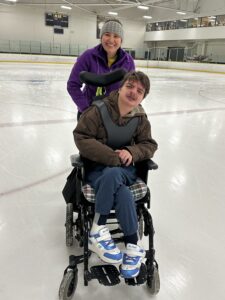 Tracey Winkler
Title: Physical Therapist
Years at High Point: 3 years
Can you describe what supports you offer students? I work with Young Adult students aged 18-26 at High Point, with varying degrees of cognitive and physical impairments that affect their positioning and mobility. I support these students with accessing their education, by training classroom staff on individualized transfers, and with the use of specialized equipment for each student during daily tasks and classroom activities. This equipment includes upright standers, adaptive toilet chairs, adaptive desk chairs, adaptive bicycles, gait trainers, and power wheelchairs.
Can you describe a typical day for you? Each day consists of supporting my students and the classroom staff during mobility activities built into the school day. This can include transferring on and off equipment, assisting students with standing and walking or working on mobility goals. In addition, I support students during mobility opportunities outside the classroom which can include adaptive swimming or community-based activities like adaptive ice skating or walking/biking at the local mall.
Other programs offered
High Point offers a variety of additional supports for students with disabilities, in addition to the traditional therapies offered. The school also offers: social work, school psychology, adaptive aquatics and consultations with medical specialists, among other supports.
Contact
For more information about enrollment and programs at High Point School, reach out to Ashley Kryscynski, MSW, Director of Communications and Public Relations at [email protected] or (734) 994-8100 x1321.