
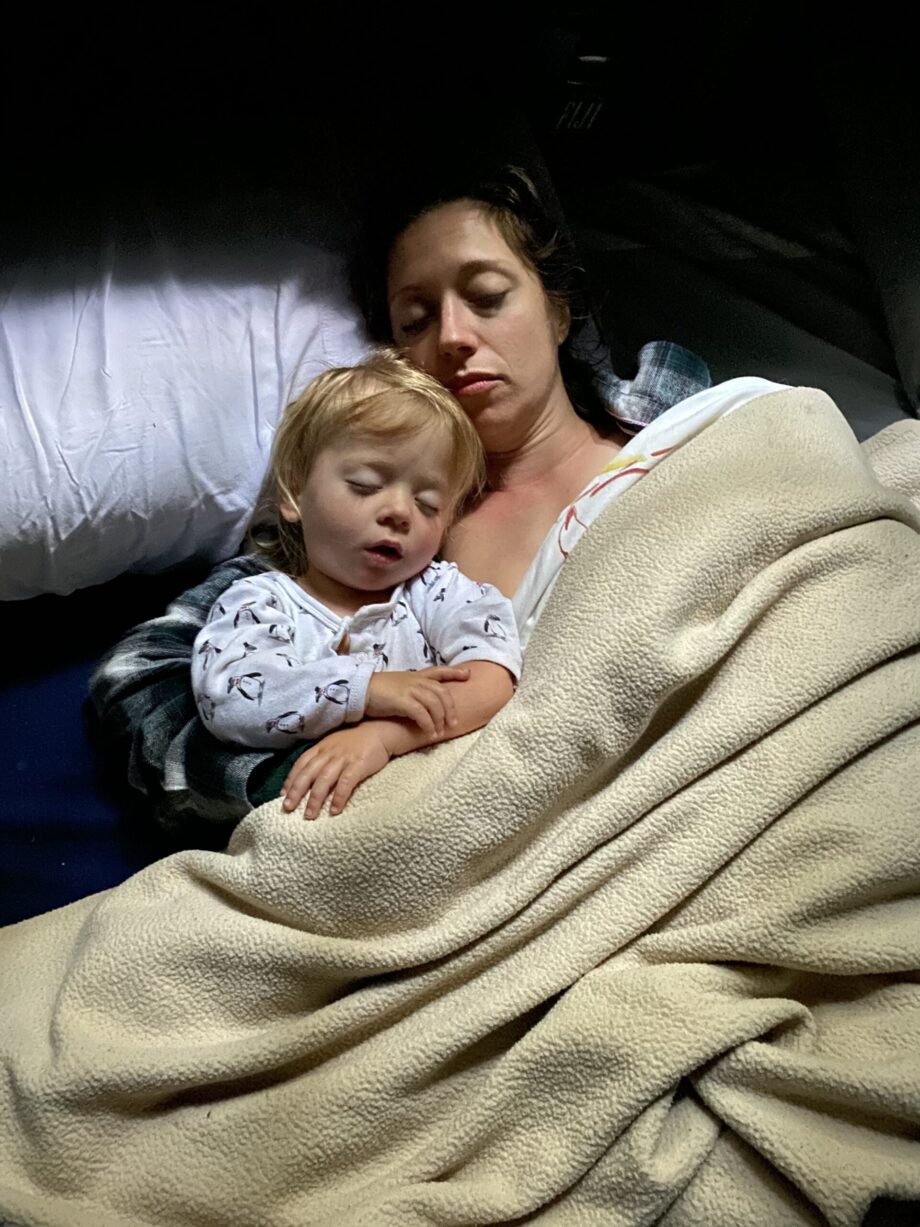
I’m a triplet mom (my babes are 22mos) and my kiddos have a lot of health issues that cause sleep issues: anemia, lead exposure, body tension, sleep apnea, neurodivergence.
Average nighttime wakes would range from a great night (under 20 wakes, still considered brutal in the parenting world), to a horrible night (over 50 wakes).
As you can imagine, I was highly motivated to figure out any way to optimize their sleep.
Yet with so many diagnosed health issues, sleep training was contraindicated.
So I set out to scour books, articles, blogs and the opinions of fellow parents and medical specialists to compile the best tips and tricks to help my kiddos sleep.
As a Montessori educator of over ten years, I already knew a lot about child development, but not a lot about biologically normal and supportive infant sleep.
I discovered a lot of nighttime success actually happens in the hours before bed.
RELATED: Lead Poisoning in Children: There is No Safe Level
Here are some of my tips and tricks, aligned with the Montessori philosophy, that have helped optimize my babies’ sleep, even with their health struggles.
Understand what’s “normal” for kids’ sleep – it’s (horrifyingly) extremely variable.

Many parents swear by a “7pm-7am” schedule for their children. However, this practice many not work for everyone. Some children do sleep a classic 12 hours. But many children don’t. According to the National Sleep Foundation, between 14-17 hours of sleep in a 24 hour period for babies 0-3 months is recommended. But as little as 11 hours to as many as 19 hours may be appropriate, pending the baby’s temperament and health needs.
That’s a difference of up to eight hours in a 24hr period!
This means you could have a baby who will sleep 7pm-7am, and then takes three 2hr naps throughout the day…or you could have a baby who sleeps 9pm-7am, and takes one 1hr nap — and those BOTH would be totally normal.
If you are the parent whose baby is on the lower end of the sleep needs scale, you are getting notably fewer breaks and notably less sleep than the parent whose baby sleeps more.
And as our kiddos age, the spectrum of normal variability in sleep continues.
Your kiddo’s not broken if a 7-7 doesn’t work for them, or if they drop their nap “too soon”. It may be they just have lower sleep needs.
Bedtime starts hours before bed
By doing this, you are laying the groundwork for a successful bedtime that incorporates blowing off physical steam, fostering a sense of safety and connection, and utilizing techniques that calm the body before beginning your actual “bedtime routine”.
If you wait till your 7pm bedtime to realize that your toddler still has boundless energy, going gently into that good night is going to be unsuccessful. But if at 5pm you start exhausting that energy, you’re much more likely for them to crash at bedtime.
So before bed:
Get out that energy! Run, chase, ride bikes, jump on pillows. The summer nights are warm and long, so if you can take this energy outside, all the better, as fresh air can help kiddos fall asleep easier too.
Sometimes high-energy exercise can keep kids up, so doing it a couple hours before bedtime still gets out all the wiggles while giving your kiddo time to wind down after.
Fostering a sense of safety and connection. Whether your baby cries when you unlatch them, bolts upright when you try to lay them down “drowsy but awake,” or asks for 2,847,915 cups of water — these can all be bids for connection. And children can’t fall asleep easily without feeling safe. (Really, who of us can?)
Fill your little one’s connection cup before bed — cuddles, storytime, songs. Any nurturing 1:1 time is connection time. If you have several kiddos, even a few minutes of 1:1 time per kiddo can make a difference.
If you need to spend time with all the kiddos together, perhaps rotate out some special attention, like each kiddo gets to pick a book and sit on your lap while you read their chosen story.
Techniques that calm the body. Here’s where we can incorporate the soothing tips and tricks we might associate with going to sleep: meditation, yoga, relaxation techniques.
If you have a teeny baby, you can still do these things! Gently squeezing and releasing your baby’s feet and limbs creates calm. Your baby may respond to dry brushing, a lotioned massage, skin-to-skin belly breathing.
For toddlers (these work for older kids too!), try bringing the exercise intensity down. Can you pretend to be a turtle in its shell, a stretching dog, a hissing snake? These are fun ways to introduce yoga poses.
Practice deep breathing by blowing out birthday candles, puffing on a dandelion, or growling like a lion. Give your toddler a massage, play with sensory toys, do some artwork, read a story.
Set the environment.
As a Montessori teacher, “a prepared environment” is one of the keystones of the educational philosophy. It means if you thoughtfully create an ordered, maximized space, the environment will do half the work for you.
For bedtime, this meant blackout curtains, a noise machine (be mindful about decibel level), and a comfortable temperature (for my kids, this was around 68-70 with sleepers but no sleep sacks).
I found an awesome planetarium projector (recommended by one of the OTs I follow on Instagram) and used this during bathtime to help dim the lights and set the mood for bedtime. My kiddos exclaim, “Stars!” every bathtime; and it helps to say, “Look at the stars!” when it’s time to rinse hair.
Make sure all physical needs are met.
If your kiddo is genuinely hungry or thirsty, they’ll have a hard time falling asleep. Usually an hour before bedtime, I’ll offer a snack and some water.
My children are still nursing, and often want to nurse before bed, so that helps with both hunger and thirst.
If your kiddo isn’t nursing, it’s a good idea to offer hydration at some point during the bedtime routine itself, or keep a small water bottle by the side of their bed.
Now it’s time for the actual bedtime routine.
Personally, I wanted to make my kiddos’ bedtime routine as long as necessary and as short as possible. I have three kids all the same age. I don’t want bedtime to drag on for two hours.
But, I also wanted space built into the routine itself, where if bedtime needed to be longer for one kiddo in particular on any given day, it flowed with minimal interruption to their routine.
Here’s my 22 months kiddos’ routine now and after months of tweaking, the core elements have been consistent for over a year:
8:50pm: dance party. (It can be as high energy or low energy as necessary, pending on the state of their bodies.)
9pm: upstairs playtime while the bath is drawn. (Varies between jungle gym, jumping on bed, or stories.)
9:10pm: bathtime and medications.
9:30pm: jammies, lotion, toothbrushing.
9:40pm: the tiredest kiddo goes to lay down/nurse/sing songs in bedroom with their preferred parent. The other two kiddos either read stories with remaining parent or engage in independent play.
?? Once tiredest kiddo is sleep, remaining two kiddos are put to sleep.
This is the most flexible part of the routine, hence the question marks on the timeline.
Sometimes the remaining two kiddos are ready for sleep quickly; sometimes there’s a maverick who isn’t ready to sleep till they read a dozen stories and get tickled and chased for an hour.
However, when you have a routine like this, any part of it can be elongated if necessary if it’s just that sort of day.
I’ve definitely done 45 minute bathtimes because the kiddos seemed to need more playtime even though it was “bedtime”, and since it was part of such a clear routine (they all know we’re doing jammies & then sleep after bath!), it didn’t disrupt their sense of order.
“Following the child,” or doing our best to honor what the child’s body and heart is indicating they want or need, is another key Montessori element.
Having flexibility in the bedtime routine to meet the child where they’re at on any given day, rather than rigidly imposing my personal timeline on them, helps to foster respect and independence for the child and their relationship with us. (Even if it’s inconvenient for us adults at times!)
My current kiddos’ bedtime routine has a way to release energy (dance party); relax the muscles and lower the body temperature (bath); soothe and calm the body (lotion, storytime cuddles); engage and quiet the mind (storytime, independent play); connect with a parent (bathtime play; storytime); and be supported to fall asleep with a prepared environment (darkened bedroom, sound machine) and connection (songs and cuddles).
At the end of the day, you can’t force sleep. All you can do is set the stage for sleep to be encouraged, but it’s up to your kiddo to do the rest!

Flexibility for summer.
The helpful thing about relying on routines, rather than merely the clock, is that you have some flexibility around the time that you start bedtime, but you can still maintain your kiddo’s sense of sleep hygiene. If you’re a half hour later getting to bathtime, they still know that once the routine starts, it’s bathtime/jammies/ toothbrushing/ bed.
That’s also the advantage of having a simple bedtime routine, rather than an elaborate one. A more elaborate routine is bound to have some of it cut out on those busy days when bedtime is pushed later than you want. And cutting parts of a routine can easily trigger meltdowns and tantrums in little kiddos, especially when they’re already tired or crabby.
Having a bedtime routine that’s just the bare necessities helps ensure that you can speed through it when you need to.


