
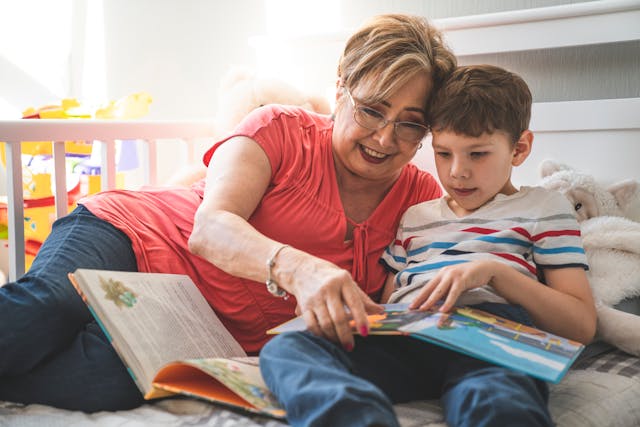
Have you ever heard of the term grandfamily? maybe not. But this family dynamic—grandparents raising their grandchildren full-time—has existed throughout history.
Grandmas and grandpas quietly step in when they’re needed, because that’s what families do: care for their loved ones, especially the littlest among them.
In Michigan, over 50,000 children are being raised by grandparents.
Kinship care
Grandfamilies are part of a broader concept known as kinship care, where relatives or other loved ones raise children instead of their parents. Sometimes that includes fictive kin—people not biologically related but close to the family, such as a godparent, family friend or coach.
With about 10,000 children in Michigan’s foster care system, more than half are in kinship care, most often with grandparents, followed by aunts and uncles.”
Challenges of kinship care
- Financial strain: Most kinship caregivers are low-income or retired; without stipends, they face significant hardship.
- Legal barriers: Caregivers without custody struggle with school enrollment and medical care approval.
- Isolation and stigma: Grandparents often feel judged, left out of peer circles or blamed for their adult children’s struggles.
Benefits of kin care
- Improved stability: Children in kinship care experience fewer placements and school changes.
- Better health outcomes: Studies show children placed with relatives have stronger behavioral and mental health than peers in non-kin foster care.
- Stronger family bonds: Kinship placements preserve family and cultural ties, and can increase chances of reunification with parents.
Formal vs. informal
Licensed foster families are what you might typically think of when a child is in foster care. In exchange for caring for the child, they receive stipends, Medicaid and social worker support. However, roughly 35% of formal kin placements remain unlicensed, meaning those caregivers do the same work with far fewer resources.
And outside the system, another 49,000 children live in informal arrangements—relatives stepping in without court orders, stipends or case workers. Those families have historically received little to no state support at all.
Progress and gaps
Much of this inequality is beginning to change. In 2024, Michigan became the first state federally approved to adopt a simplified licensing process for kinship foster homes. Relatives can now be licensed more quickly and access the same support as traditional foster parents.
In 2025, the Michigan Department of Health and Human Services launched an expanded kinship support program, adding 70 kinship support workers statewide to help both formal and informal caregivers navigate resources and reduce placement breakdowns.
MDHHS and partner agencies are embedding a “kin-first” approach across child welfare—prioritizing relatives or close family friends whenever a child must be removed from their home. By prioritizing family-based placements, Michigan cut the number of children in institutional care from over 1,000 in 2019 to under 400 in 2023.
But the fact remains: the majority of Michigan’s kinship caregivers are informal, outside foster care and still without financial support.
RELATED: Four crucial ways to support your teen’s identity
Resources for kinship families
Statewide entry points for kinship caregivers
Michigan State University – Kinship Care Resource Center (KCRC)
The KCRC is Michigan’s primary statewide hub for kinship caregivers. It offers education, outreach and a toll-free helpline (1-800-535-1218) where caregivers can talk directly with staff about their needs. KCRC provides referrals to legal aid, financial supports, school enrollment help and local services. The center is especially important for informal caregivers who may not be connected through foster care but still need help navigating guardianship, healthcare and school systems.
MSU School of Social Work. 655 Auditorium Rd, East Lansing
Children’s Trust Michigan (CTM)
Part of the Michigan Department of Health and Human Services, CTM focuses on preventing child abuse and neglect and supporting caregivers who are raising children full-time. CTM funds kinship support programs, connects families to help and works to ensure children feel safe and connected in their kinship homes. CTM is also a key partner in the MichiKIN network.
235 S Grand Ave, Suite 1411, Lansing
Michigan 2-1-1 (United Way)
A free, statewide phone line and website that connects Michigan residents to local resources and emergency services. Caregivers can dial 2-1-1 at any time for referrals to food, housing, utility assistance, counseling and kinship caregiver supports in their area. 2-1-1 is often the fastest entry point for immediate needs while families connect with longer-term programs like KCRC or MichiKIN.
Virtual
MichiKIN Network
This statewide network of local and community partners work together to support kinship families who can be referred into the network through KCRC, Children’s Trust Michigan, or community agencies. MichiKIN helps caregivers connect with resources for mental health, education, child welfare, permanency planning and everyday needs. It is designed to be a navigation system—helping caregivers find the right help without having to search on their own.
Virtual
Peer support and caregiver resources
Catholic Social Services of Washtenaw – Grandparents as Parents (GAP)
GAP offers peer groups, workshops, newsletters and referrals for grandparents raising grandchildren. They provide help with food, clothing, transportation, tutoring and special needs.
4925 Packard St, Ann Arbor
Fostering Forward Michigan
This is a peer-led statewide network of foster, adoptive and kinship families, offering mentoring, training and advocacy.
3355 S Wayne Rd, Wayne
Michigan CASA (Court Appointed Special Advocates)
CASA volunteers serve as consistent adult advocates in the court system for foster youth in formal placement. They help judges understand a child’s life outside the case file and ensure at-risk kids get what they need.
1200 N Telegraph Rd, Bldg 14E, Pontiac
Washtenaw Foster Care Coalition (Facebook)
A local coalition sharing events, resources and advocacy opportunities. A way for foster and kinship caregivers to connect with each other.
Virtual (Facebook-based)
Education & Youth Support
Student Advocacy Center – Foster Care Education
Helps foster and court-involved youth stay enrolled, access special education, avoid unfair suspensions and assert their rights in school.
715 N University Ave, Ste 270, Ann Arbor
WCC REACH Program (Washtenaw Community College)
Supports college students with foster care or homelessness experience through scholarships, mentoring and academic help.
4800 E Huron River Dr, Ann Arbor
Blavin Scholars Program – University of Michigan
Provides scholarships, mentoring and life-skills training for U-M students with foster care experience.
2011 Student Activities Building, Ann Arbor
Transition-age youth and independent living
Our House MI
Safe housing, mentoring and life-skills training for youth aging out of the foster care system in Washtenaw County.
1300 W Huron River Dr, Ypsilanti
Youth Empowerment & At-Risk Supports
Big Brothers Big Sisters of Washtenaw County
Matches youth with mentors who provide one-on-one support, guidance and encouragement. Many foster and kinship youth benefit from BBBS relationships.
730 Spring St, Ann Arbor
JFS of Ann Arbor – Youth Empowerment Programs
Resiliency coaching, mentoring and life-skills workshops designed for at-risk youth—including foster and kinship youth.
2245 S State St, Ste 200, Ann Arbor
Neutral Zone
A teen center in Ann Arbor offering leadership, arts and advocacy opportunities. Creates a safe, supportive space for youth, including those in foster or kinship care.
310 E Washington St, Ann Arbor
Ozone House
Provides crisis shelter, counselingand wraparound supports for homeless and at-risk youth ages 10–24, including kinship youth.
1705 Washtenaw Ave, Ann Arbor


